The "Andromeda Strain" is a 1971 science-fiction film, based on the novel published in 1969 by Michael Crichton. Probably is the best "microbiological" movie. The film is about a team of scientists who investigate a deadly organism of extraterrestrial origin that causes rapid, fatal blood clotting. But Andromeda has other surprises. This clip includes the famous scene of the "death monkey".
Showing posts with label Scientific Research. Show all posts
Showing posts with label Scientific Research. Show all posts
Friday, February 11, 2011

Wednesday, February 9, 2011
The Andromeda Strain (1971) Photoincineration
The "Andromeda Strain" is a 1971 science-fiction film, based on the novel published in 1969 by Michael Crichton. Probably is the best "microbiological" movie. The film is about a team of scientists who investigate a deadly organism of extraterrestrial origin that causes rapid, fatal blood clotting. But Andromeda has other surprises. In this fragment, we can see the different sterilization and aseptic procedures taken as a precaution to avoid external contamination. Nowadays we know that some of these creates more harm than good, as for example the removal of the skin and intestinal microbiota. In this fragment there is also a interesting reference to the Bracewell probe, the possibility that an alien lifeform could be use as a comunication device.

BRACEWELL, R. (1960). Communications from Superior Galactic Communities Nature, 186 (4726), 670-671 DOI: 10.1038/186670a0
Monday, February 7, 2011
The Andromeda Strain (1971) Wildfire laboratory
The "Andromeda Strain" is a 1971 science-fiction film, based on the novel published in 1969 by Michael Crichton. Probably is the best "microbiological" movie. The film is about a team of scientists who investigate a deadly organism of extraterrestrial origin that causes rapid, fatal blood clotting. But Andromeda has other surprises. In this fragment, Dr Stones describes the Wildfire laboratory.
Saturday, February 5, 2011
The Andromeda Strain (1971) Opening credits

The "Andromeda Strain" is a 1971 science-fiction film, based on the novel published in 1969 by Michael Crichton. Probably is the best "microbiological" movie. The film is about a team of scientists who investigate a deadly organism of extraterrestrial origin that causes rapid, fatal blood clotting. But Andromeda has other surprises.
Tuesday, November 9, 2010
Arrowsmith (1931) Bioethical issues
Arrowsmith faces a difficult bioethical decision. The effectiveness of the cure against plague should be tested by an experiment. But this time the experimental subjects are others.
Saturday, November 6, 2010
Arrowsmith (1931) Discovering bacteriophages
After two years of fruitless research, Arrowsmith thinks that he had a jackpot. Something kills the bacteria. But deception awaits.
Friday, November 5, 2010
Arrowsmith (1931) New lab
At last, Arrowsmith has a position as a scientific researcher. Now, he has a new Laboratory with state of the art technology. Here he meet again with his mentor.
Friday, October 29, 2010
Arrowsmith. (1931)
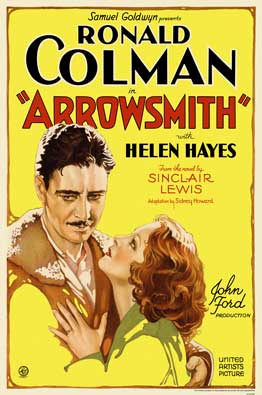
Image source: Wikipedia
Directed by John Ford in 1931 and based in the novel of the same name wrote by Sinclair Lewis.
Here are a selection of different sequences with microbiological interest. The videos are commented by notes.
1.- Looking for a laboratory
Subscribe to:
Posts (Atom)